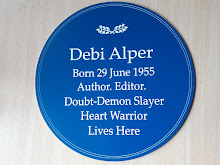
Further to the last post about newly-agented author, Roger Hardy, in which I bemoaned his lack of an online presence, I'm delighted to point you in this direction.
Roger appears to think I have supernatural powers. I'm not about to tell him otherwise. He also thinks that I'm the kind of person he'd like to get drunk with. I ain't sayin' nothin' on the score either.
Thursday, June 23, 2011

Monday, June 20, 2011
Oh, thank you, universe!
Almost exactly a year ago, I published this post. In it, I said:
I'M CONVINCED THAT THE DAY WILL COME WHEN I HAVE A GEN-U-INE ROGER HARDY BOOK ON MY SHELVES THAT HAS THE LOGO OF A MAJOR PUBLISHING COMPANY ON THE SPINE.
Today, I'm delighted to say that Roger has just made a giant leap forward in his journey towards publication. He emailed to say that he has been signed up for his sixth book by Peter Buckman from the Ampersand agency. The two met at the York Festival of Writing in 2010 and I'm sure they'll make a wonderful team. I'm now sprinkling fairy dust on Peter's efforts to secure a mega deal for Roger.
There's still no link for Roger, though I'm sure that's going to change at some point. But there is a link to a lovely post on the WordCloud that has me blushing so much you could make toast on my cheeks.
I'M CONVINCED THAT THE DAY WILL COME WHEN I HAVE A GEN-U-INE ROGER HARDY BOOK ON MY SHELVES THAT HAS THE LOGO OF A MAJOR PUBLISHING COMPANY ON THE SPINE.
Today, I'm delighted to say that Roger has just made a giant leap forward in his journey towards publication. He emailed to say that he has been signed up for his sixth book by Peter Buckman from the Ampersand agency. The two met at the York Festival of Writing in 2010 and I'm sure they'll make a wonderful team. I'm now sprinkling fairy dust on Peter's efforts to secure a mega deal for Roger.
There's still no link for Roger, though I'm sure that's going to change at some point. But there is a link to a lovely post on the WordCloud that has me blushing so much you could make toast on my cheeks.
Friday, June 17, 2011
Being a Lazy Blogger
Actually, that's not strictly true. I'm not being lazy, just veryveryvery busy. And, before you ask, that doesn't mean I've abandoned the blogosphere for Facebook and Twitter.
(Though if you twist my arm, I'd have to confess that I am there quite a bit. That's the difference between a post that takes seconds and one that needs more thought and time. You bloggy people are s-o-o-o demanding.)
Anyway, I'm just popping in to let you know that you can have a sneaky peek into my glamorous lifestyle, thanks to Michelle Teasdale at Winning Words. And, yes, I 'met' Michelle through Facebook, so there.
Also, East Dulwich Writers' Group have a couple of gigs coming up, the first being this Sunday as part of Bromley Literary Festival. Further details of EDWG events are on the group website.
There's lots of other stuff I'd love to share but I'm afraid it's going to have to wait ... Mainly, because I need to dash off and do said 'other stuff'.
If you haven't already done so, please track me down on Facebook and Twitter.
I look forward to seeing you there ... and there ... and sometimes here.
(Though if you twist my arm, I'd have to confess that I am there quite a bit. That's the difference between a post that takes seconds and one that needs more thought and time. You bloggy people are s-o-o-o demanding.)
Anyway, I'm just popping in to let you know that you can have a sneaky peek into my glamorous lifestyle, thanks to Michelle Teasdale at Winning Words. And, yes, I 'met' Michelle through Facebook, so there.
Also, East Dulwich Writers' Group have a couple of gigs coming up, the first being this Sunday as part of Bromley Literary Festival. Further details of EDWG events are on the group website.
There's lots of other stuff I'd love to share but I'm afraid it's going to have to wait ... Mainly, because I need to dash off and do said 'other stuff'.
If you haven't already done so, please track me down on Facebook and Twitter.
I look forward to seeing you there ... and there ... and sometimes here.
Wednesday, May 25, 2011
I've joined the Twitterati!
Can't believe I've done it! I'm on a writing retreat and an unexpected side effect is that my lovely host has persuaded me to join Twitter.
So now, as well as this neglected blog, a hideously out-of-date website, a very busy Facebook page and various forums, I have a new distraction.
I blame the gin.
If this means anything to you, check me out at @DebiAlper
So now, as well as this neglected blog, a hideously out-of-date website, a very busy Facebook page and various forums, I have a new distraction.
I blame the gin.
If this means anything to you, check me out at @DebiAlper
Thursday, May 19, 2011
The People Collector
Authors are often asked where we get our ideas and characters from. Friends and relatives have even been known to be nervous that fictional characters might be based on them. I was shocked and saddened when my sister-in-law asked if the sister-in-law in my Nirvana series was supposed to be her.
The fictional version is shallow and snobbish. Surely, my real sister-in-law didn't think I see her in this way. (I really don't.) And, even if I did, did she believe I would abuse our relationship by sharing my negative perceptions of her with the world?
The truth is, I do collect characters, but no one who knows me would ever be able to recognise themselves in my books. Most of my inspiration comes from people I encounter but know nothing about. My favourite people-spotting opportunities come from bus journeys.
I always sit on the top deck by the window. I look down on shoppers, workers, wanderers, seeing them from a different angle to the norm. Where is she going? What does his home look like? Where does she work? What's their story? I peep into uncurtained first floor windows to get a fleeting glimpse of people's internal landscapes; odd ornaments on the window sill, a torn sheet instead of a curtain, piles of old newspapers, a row of polished trophies ...
I can give full rein to my imagination. The stories I weave most likely bear no resemblance to the truth. Or do they? They might be eerily accurate. But it doesn't matter one way or another, because the person I've observed will never know they've inspired a story.
A little closer to the bounds of propriety, I like to eavesdrop on conversations. Take last week, for example. In the seat behind me, a teenage girl was talking about the tradition in her private school of playing pranks when pupils leave at the end of Year 11. Her personal favourite, she told her unseen companion, was when a group of pupils got hold of a cow. (At great expense, she added.) Cows, she went on to say, can go up stairs, but not down. Somehow, they managed to smuggle the animal into the school and up the stairs, where they abandoned it. With no alternative, the school was forced to arrange for the poor (and, no doubt, distressed) beast to be rescued by helicopter. Presumably, at further great expense.
The girl moved on to talking about her plans for the summer: a week at the family villa in France followed by a journey south for an extended stay in St Tropez.
I resisted the urge to turn round, so I never saw what she looked like. But she was speaking loud enough for me to hear (which is saying something) and appeared to have no concept of the extent of her privilege, or that most of her fellow travellers might inhabit a very different universe.
That girl might appear as a cameo in a story some time. The challenge for me would be to lift her beyond stereotype. I was so engrossed that it took me a while to realise I was on the wrong bus.
The next bus (the right one this time) provided contrasting, but equally fertile, ground for harvesting characters. Two middle-aged Jamaican men were discussing the iniquitous cost of a TV licence, which both agreed was a struggle for poor people to afford. From there, they moved on to talk about international politics and the subtle differences in the way racism is manifested in the US and the historical reasons for those differences. Then it was current affairs: whether the authorities in Pakistan had been aware of Bin Laden's whereabouts. By the time I left the bus, they'd become involved in a complex discourse on the nature of fear.
Rich pickings for a novelist: these men and their (possible) personal stories; any of the subjects they touched on; the rhythms and patterns of their speech; the timbre of their voices ... In many ways, the sheer depth of the insights these men gave means that they would be far easier for me to bring to life in a fictional setting than the girl would be, lifting them beyond the risk of cliche and stereotype.
So, whether you're sitting on the top of a bus, shopping in the supermarket, walking on the streets, wandering in the park, queueing at the post office ... keep your eyes and ears open.
And if you're not a novelist, be aware that the person in the next seat might be watching you and listening to your words, storing them away for future use.
So, do you reckon this is OK? Or is it a form of identity theft? And does it matter one way or the other?
The fictional version is shallow and snobbish. Surely, my real sister-in-law didn't think I see her in this way. (I really don't.) And, even if I did, did she believe I would abuse our relationship by sharing my negative perceptions of her with the world?
The truth is, I do collect characters, but no one who knows me would ever be able to recognise themselves in my books. Most of my inspiration comes from people I encounter but know nothing about. My favourite people-spotting opportunities come from bus journeys.
I always sit on the top deck by the window. I look down on shoppers, workers, wanderers, seeing them from a different angle to the norm. Where is she going? What does his home look like? Where does she work? What's their story? I peep into uncurtained first floor windows to get a fleeting glimpse of people's internal landscapes; odd ornaments on the window sill, a torn sheet instead of a curtain, piles of old newspapers, a row of polished trophies ...
I can give full rein to my imagination. The stories I weave most likely bear no resemblance to the truth. Or do they? They might be eerily accurate. But it doesn't matter one way or another, because the person I've observed will never know they've inspired a story.
A little closer to the bounds of propriety, I like to eavesdrop on conversations. Take last week, for example. In the seat behind me, a teenage girl was talking about the tradition in her private school of playing pranks when pupils leave at the end of Year 11. Her personal favourite, she told her unseen companion, was when a group of pupils got hold of a cow. (At great expense, she added.) Cows, she went on to say, can go up stairs, but not down. Somehow, they managed to smuggle the animal into the school and up the stairs, where they abandoned it. With no alternative, the school was forced to arrange for the poor (and, no doubt, distressed) beast to be rescued by helicopter. Presumably, at further great expense.
The girl moved on to talking about her plans for the summer: a week at the family villa in France followed by a journey south for an extended stay in St Tropez.
I resisted the urge to turn round, so I never saw what she looked like. But she was speaking loud enough for me to hear (which is saying something) and appeared to have no concept of the extent of her privilege, or that most of her fellow travellers might inhabit a very different universe.
That girl might appear as a cameo in a story some time. The challenge for me would be to lift her beyond stereotype. I was so engrossed that it took me a while to realise I was on the wrong bus.
The next bus (the right one this time) provided contrasting, but equally fertile, ground for harvesting characters. Two middle-aged Jamaican men were discussing the iniquitous cost of a TV licence, which both agreed was a struggle for poor people to afford. From there, they moved on to talk about international politics and the subtle differences in the way racism is manifested in the US and the historical reasons for those differences. Then it was current affairs: whether the authorities in Pakistan had been aware of Bin Laden's whereabouts. By the time I left the bus, they'd become involved in a complex discourse on the nature of fear.
Rich pickings for a novelist: these men and their (possible) personal stories; any of the subjects they touched on; the rhythms and patterns of their speech; the timbre of their voices ... In many ways, the sheer depth of the insights these men gave means that they would be far easier for me to bring to life in a fictional setting than the girl would be, lifting them beyond the risk of cliche and stereotype.
So, whether you're sitting on the top of a bus, shopping in the supermarket, walking on the streets, wandering in the park, queueing at the post office ... keep your eyes and ears open.
And if you're not a novelist, be aware that the person in the next seat might be watching you and listening to your words, storing them away for future use.
So, do you reckon this is OK? Or is it a form of identity theft? And does it matter one way or the other?
Friday, April 22, 2011
Resources
I'm cheating here because this isn't a post as such, just a series of links. And some of them are links to posts that consist mostly of ... links to posts. Allow me to justify why this qualifies as the most Boring but Useful post on my blog.
I'm one week into the online self-editing course I'm running together with Emma Darwin on behalf of the Writers' Workshop.
It's going really well. Writers of all ages and in all genres, living in different continents and environments, all working together with the same aim: to produce the best possible writing. Love it, love it, love it.
In my feedback, I kept finding myself wanting to link to a blog post. If you're reading this, you'll know that, unlike Emma's blog, this isn't a lit blog as such. It's a hotchpotch mishmash soupy stew of rants mixed with tips and info, seasoned with a dash of laughter and with some spicy personal details sprinkled over the top.
In amongst this seemingly random jumble, there are some posts about the writing process but each time I want to link to them, I have to spend ages sieving through the other stuff to track them down.
So here are the links to the last couple of years' lit posts, all served up on one platter.
Success Stories
Sean Walsh
Catherine Cooper
The Thickest Skin (Jason Wallace - a prizewinner after 100 (!) rejections)
A Tale of Two Authors (Shelly Harris and Roger Hardy)
Why write?
Reasons for writing
Submissions
Dear ... Me ....
Festival of Writing posts
York 2011
York 2010 - check posts in April 2010
'Rules'
The Rule Breaker
The Rule Hater
The writing process
The writing gardener
The writing addict
Anyone Else Feel a Draft in Here?
Debi Does Quantum
Naming characters
Plagiarism
Writer or Thief?
I'm one week into the online self-editing course I'm running together with Emma Darwin on behalf of the Writers' Workshop.
It's going really well. Writers of all ages and in all genres, living in different continents and environments, all working together with the same aim: to produce the best possible writing. Love it, love it, love it.
In my feedback, I kept finding myself wanting to link to a blog post. If you're reading this, you'll know that, unlike Emma's blog, this isn't a lit blog as such. It's a hotchpotch mishmash soupy stew of rants mixed with tips and info, seasoned with a dash of laughter and with some spicy personal details sprinkled over the top.
In amongst this seemingly random jumble, there are some posts about the writing process but each time I want to link to them, I have to spend ages sieving through the other stuff to track them down.
So here are the links to the last couple of years' lit posts, all served up on one platter.
Success Stories
Sean Walsh
Catherine Cooper
The Thickest Skin (Jason Wallace - a prizewinner after 100 (!) rejections)
A Tale of Two Authors (Shelly Harris and Roger Hardy)
Why write?
Reasons for writing
Submissions
Dear ... Me ....
Festival of Writing posts
York 2011
York 2010 - check posts in April 2010
'Rules'
The Rule Breaker
The Rule Hater
The writing process
The writing gardener
The writing addict
Anyone Else Feel a Draft in Here?
Debi Does Quantum
Naming characters
Plagiarism
Writer or Thief?
Tuesday, April 05, 2011
Of course ...
I've just realised it's April. How did that happen?
Just a quick post to let people know about some courses on offer this month (Quick because I have to dash off to do the prep for them!)
On 30th April, I'm running a 1 day workshop in Waterloo on behalf of Writers' Workshop. It's a How to Write Your Novel course, aimed at people who want to learn the basics and costs £99 (includes lunch, refreshments and a discount voucher for WW services).
If you're looking for something more advanced and want to work online and at your own pace as well as receive feedback on your own writing, Emma Darwin and I are co-leading a 6 week course beginning 16th April: Self-Editing Your Own Novel.
For details of both go here and click on the date of the course you're interested in or follow the links above.
If you can't afford any of the above but are looking for help with techniques, feedback from fellow writers, or just general chat with a warm and supportive community, I strongly recommend you get yourself over to WordCloud which is free and you can't say fairer than that!
Just a quick post to let people know about some courses on offer this month (Quick because I have to dash off to do the prep for them!)
On 30th April, I'm running a 1 day workshop in Waterloo on behalf of Writers' Workshop. It's a How to Write Your Novel course, aimed at people who want to learn the basics and costs £99 (includes lunch, refreshments and a discount voucher for WW services).
If you're looking for something more advanced and want to work online and at your own pace as well as receive feedback on your own writing, Emma Darwin and I are co-leading a 6 week course beginning 16th April: Self-Editing Your Own Novel.
For details of both go here and click on the date of the course you're interested in or follow the links above.
If you can't afford any of the above but are looking for help with techniques, feedback from fellow writers, or just general chat with a warm and supportive community, I strongly recommend you get yourself over to WordCloud which is free and you can't say fairer than that!
Thursday, March 31, 2011
Post York Posts - success stories!
Some wonderful news to share!
I met Sean Walsh at York 2010 in a Book Doctor session and was blown away by his children's fantasy book, Peripherealm, and his mind-blowing illustrations. I worked with him during the year, in the course of which we cut 50,000 words. (It was a very long book!) Then he started pitching. As the rejections started coming in, I don't know how many times I had to convince him not to give up.
He came to York again this year and ... well, let's just say I wasn't going to let the opportunity pass to ensure Sean's book got the attention I was convinced he deserves.
And ... to cut a long story square, as my dad would say ... Sean has now been signed up, just a day after the Festival, by David Headley!
See full story, including Sean's own response, here.
That's not all my good news. I have another example of how persistance will pay off, if your book is good enough and you are committed to doing whatever it takes to make it the best it can possibly be. Another children's author with whom I've worked has also been signed up with an agent. Katherine Hetzel had a Writers' Workshop edit with Michelle Lovric and then 2 further edits and extended conversations with me before she began pitching. I'm too modest *cough* to repeat here what she said about the part I played in enabling her book to reach its potential, but I will say what an absolute joy it is to be a part of these journeys and to know that I've had a role to play. WordCloud link to this news is here.
One last story. It doesn't end with an agent signing an agreement, like Sean and Katherine's, though who knows what's around the corner? Do you remember me telling you about DW? The man who was determined to prove me wrong when I suggested he may not be ideally suited to writing fiction?
DW tracked me down at York and with great glee told me that 2 agents had asked to see more of the MS he pitched to them that we have been working on together. I've never been so pleased to be proved wrong.
So - whoever you are and wherever you are - don't ever give up. The right words, in the right time and the right place, and you too can experience this magic.
PS: feedback from York is now up on the Festival site.
I met Sean Walsh at York 2010 in a Book Doctor session and was blown away by his children's fantasy book, Peripherealm, and his mind-blowing illustrations. I worked with him during the year, in the course of which we cut 50,000 words. (It was a very long book!) Then he started pitching. As the rejections started coming in, I don't know how many times I had to convince him not to give up.
He came to York again this year and ... well, let's just say I wasn't going to let the opportunity pass to ensure Sean's book got the attention I was convinced he deserves.
And ... to cut a long story square, as my dad would say ... Sean has now been signed up, just a day after the Festival, by David Headley!
See full story, including Sean's own response, here.
That's not all my good news. I have another example of how persistance will pay off, if your book is good enough and you are committed to doing whatever it takes to make it the best it can possibly be. Another children's author with whom I've worked has also been signed up with an agent. Katherine Hetzel had a Writers' Workshop edit with Michelle Lovric and then 2 further edits and extended conversations with me before she began pitching. I'm too modest *cough* to repeat here what she said about the part I played in enabling her book to reach its potential, but I will say what an absolute joy it is to be a part of these journeys and to know that I've had a role to play. WordCloud link to this news is here.
One last story. It doesn't end with an agent signing an agreement, like Sean and Katherine's, though who knows what's around the corner? Do you remember me telling you about DW? The man who was determined to prove me wrong when I suggested he may not be ideally suited to writing fiction?
DW tracked me down at York and with great glee told me that 2 agents had asked to see more of the MS he pitched to them that we have been working on together. I've never been so pleased to be proved wrong.
So - whoever you are and wherever you are - don't ever give up. The right words, in the right time and the right place, and you too can experience this magic.
PS: feedback from York is now up on the Festival site.
Monday, March 28, 2011
York Talk 2011 - the thanks bit
Mega thanks go to:
- Emma Darwin - for proving once again to be the perfect co-tutor for the mini course. What a team!
- all the agents, publishers and specialists who, in spite of everything, continue to demonstrate their passion for fabulous writing
- the lovely peeps on the Blackwell's stall for selling our books
- the other authors with whom I wish I could have spent more time
- all the participants for trusting us with your babies and for all the words, words, words
- the Word Clouders - what a wonderful, warm, funny and supportive community you (we) are
- Laura, Deborah and Nikki from Writers' Workshop for the hard unglamorous slog wth none of the glory
- Kate Allan for a mammoth organisational feat
- Jeremy Guy - likewise and for the toothpaste
- the staff at York for their friendly, helpful and efficient hosting
- Susan Franklin, Lesley Eames and Sandra Norval for looking after the Book Doctors and agents and for the iron fists you wield from inside your velvet gloves
- all of you for coming along for the ride, either in body or blog
- and finally to Harry Bingham, who changes lives
York Talk 2011 - in pictures
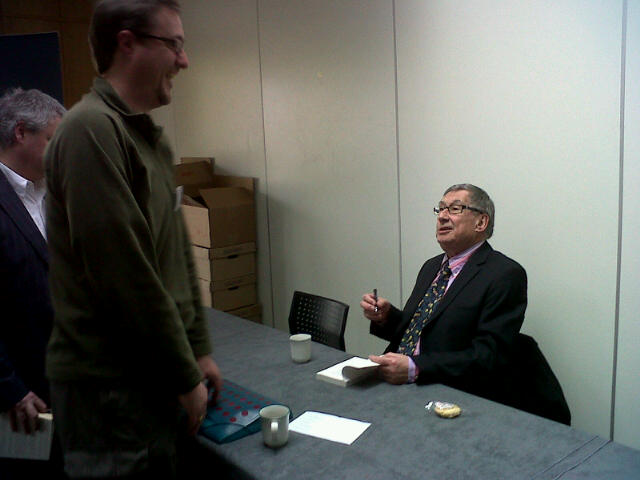
David Nobbs signing a copy of one of his many books

Some of the grand old ducks of York

Cicely Havely, winner of Authonomy Live

Emma Darwin and Jenny Beattie at the gala dinner

Harry and Laura from Writers' Workshop sifting through the competition shortlist

Kerry Fisher, winner of the Festival competition
Sunday, March 27, 2011
York Talk 2011 - ooh, goody goody.
Goody bags
This year, several publishers supplied free copies of their books, many of them hardbacks and others advance proof copies, for distribution to all at the Festival.
I was delighted to have sold several copies of my own books and thought that would mean I would go back with lighter luggage. Instead, my books were replaced by these freebies, but believe me, I ain't grumbling.
The grand finale
Kate Williams, historian and novelist, was the final speaker and she shared her personal experiences in the last key note address of the weekend. Not many people can have a week that consists of chatting to Jeremy Paxman about economic contraction on Newsnight on one evening, and then a day or so later talking about the origins of Battenberg cake.
The final, final say though, has to go to Harry Bingham, who said that he had spoken to the agents and publishers over the weekend and they had all said they were blown away by the quality of much of the writing they saw.
'Numerous agents were interested in numerous writers,' he told us.
Let's hope that several people will sign up with agents in the near future, having been asked to send their full MSes. And that those agents will succeed in getting deals for those authors. How wonderful it would be in the future for people to say their successful careers as authors began at York, as Shelley Harris was able to say last year.
Harry left us with these thoughts:
I'm home now, still dealing with that strange mixture of Knackered but Wired. The one thing that has hit me is that 300+ people in one vast room, don't seem to make nearly as much noise as 3 people (all male, 2 teenagers) in one small room.
This year, several publishers supplied free copies of their books, many of them hardbacks and others advance proof copies, for distribution to all at the Festival.
I was delighted to have sold several copies of my own books and thought that would mean I would go back with lighter luggage. Instead, my books were replaced by these freebies, but believe me, I ain't grumbling.
The grand finale
Kate Williams, historian and novelist, was the final speaker and she shared her personal experiences in the last key note address of the weekend. Not many people can have a week that consists of chatting to Jeremy Paxman about economic contraction on Newsnight on one evening, and then a day or so later talking about the origins of Battenberg cake.
The final, final say though, has to go to Harry Bingham, who said that he had spoken to the agents and publishers over the weekend and they had all said they were blown away by the quality of much of the writing they saw.
'Numerous agents were interested in numerous writers,' he told us.
Let's hope that several people will sign up with agents in the near future, having been asked to send their full MSes. And that those agents will succeed in getting deals for those authors. How wonderful it would be in the future for people to say their successful careers as authors began at York, as Shelley Harris was able to say last year.
Harry left us with these thoughts:
- No one who had been there could be in any doubt whatsoever that the entire industry runs on passion.
- It's vital to be a perfectionist - what the Festival does is to provide people with the tools to polish and perfect their writing.
- Another P word, an equally essential component in the writers' toolkit, is persistence.
- Writing is hard - so you'd better love doing it!
I'm home now, still dealing with that strange mixture of Knackered but Wired. The one thing that has hit me is that 300+ people in one vast room, don't seem to make nearly as much noise as 3 people (all male, 2 teenagers) in one small room.
York Talk 2011 - The Book Doctor is (was) in
I had 18 Book Doctor sessions over the 2 days. Obviously, and as one would expect, there was a range of genres and also of potential in those submissions. But everyone felt they learned something really useful and specific to their own writing, including the effectiveness of their concept and pitch.
I was seriously impressed with some of them. Although I was only seeing first chapters and synopses, there were some who semeed they only needed to do a bit of tightening and polishing for their books to be ready to pitch to agents. If they didn't get any bites, they might consider getting an edit, but those special few were at the stage where I suggested they should try pitching them first, on the chance that everything was already in place and they could save themselves the expense of paying for a critique.
I hope people will stay in touch as I'd love nothing better than to see them succeed and know I had a small part to play in their journey.
Which reminds me ...
I was talking to someone who has spent their former career in the highly competitive corporate world. She couldn't believe the way everyone seemed to be so generously spirited, genuinely happy to hear about and celebrate other people's success. I hadn't really thought about how unusual and extraordinary that was. I've always taken it for granted that our collective passion and enthusiasm was for all writing, not just our own. Makes me feel even more happy and lucky - privileged even - to be part of the community of writers.
On which note ...
I had to forget something crucial when I was packing, didn't I? Toothpaste, that's what. On Saturday morning, I told someone in passing that I'd forgotten mine and had had to use soup (bleurgh). An hour or so later, Jeremy Guy, one of the extraordinary team of organisers, came up to me and said he'd heard I'd forgotten my toothpaste and I really should have told him.
Eh? I think I might have goggled at him. And then 10 mins later he found me and handed over a tube that he had dispatched someone specially to buy. I know this sounds wet, but I was so touched, and felt so cared for and looked after, I felt quite teary. *sniff*
I was seriously impressed with some of them. Although I was only seeing first chapters and synopses, there were some who semeed they only needed to do a bit of tightening and polishing for their books to be ready to pitch to agents. If they didn't get any bites, they might consider getting an edit, but those special few were at the stage where I suggested they should try pitching them first, on the chance that everything was already in place and they could save themselves the expense of paying for a critique.
I hope people will stay in touch as I'd love nothing better than to see them succeed and know I had a small part to play in their journey.
Which reminds me ...
I was talking to someone who has spent their former career in the highly competitive corporate world. She couldn't believe the way everyone seemed to be so generously spirited, genuinely happy to hear about and celebrate other people's success. I hadn't really thought about how unusual and extraordinary that was. I've always taken it for granted that our collective passion and enthusiasm was for all writing, not just our own. Makes me feel even more happy and lucky - privileged even - to be part of the community of writers.
On which note ...
I had to forget something crucial when I was packing, didn't I? Toothpaste, that's what. On Saturday morning, I told someone in passing that I'd forgotten mine and had had to use soup (bleurgh). An hour or so later, Jeremy Guy, one of the extraordinary team of organisers, came up to me and said he'd heard I'd forgotten my toothpaste and I really should have told him.
Eh? I think I might have goggled at him. And then 10 mins later he found me and handed over a tube that he had dispatched someone specially to buy. I know this sounds wet, but I was so touched, and felt so cared for and looked after, I felt quite teary. *sniff*
York Talk 2011 - oh but I also forgot ... the gala dinner
A chance to dress up in our glad rags and celebrate in style. The poshest of nosh and the bestest of company. What's not to love?
The winners of the Festival competition were announced during the meal and once again it was clear just how much talent and potential there was in that room. With only my teensy evening bag, I found myself in the almost unique position of realising I didn't have pen and notebook to hand, so I didn't manage to record the shortlist. (Though I couldn't possibly forget the well-deserved inclusion of the lovely John Taylor of Word Cloud renown).
Fortunately, the winner, Kelly Fisher, was sitting at my table. Kelly won on the basis of having the most wonderful opening line to her novel and I asked her to jot it down on the back of a business card so that I could share it with you here:
Good, huh???
Sadly, the rest of the evening was a teensy bit of a blur. Absolutely no connection whatsoever with gin and anyone suggesting otherwise will be facing a libel suit.
The winners of the Festival competition were announced during the meal and once again it was clear just how much talent and potential there was in that room. With only my teensy evening bag, I found myself in the almost unique position of realising I didn't have pen and notebook to hand, so I didn't manage to record the shortlist. (Though I couldn't possibly forget the well-deserved inclusion of the lovely John Taylor of Word Cloud renown).
Fortunately, the winner, Kelly Fisher, was sitting at my table. Kelly won on the basis of having the most wonderful opening line to her novel and I asked her to jot it down on the back of a business card so that I could share it with you here:
I was wearing the wrong bra for sitting in a police cell.
Good, huh???
Sadly, the rest of the evening was a teensy bit of a blur. Absolutely no connection whatsoever with gin and anyone suggesting otherwise will be facing a libel suit.
York Talk 2011 - oh but I forgot ... that workshop
That last post refers to this morning (Sunday) but somehow I forgot some of the most crucial things that happened yesterday.
For starters, there was my Breaking the Rules workshop. I was a bit anxious about how much there was to get through and also that there were no gimmicks; all they were going to get was me talking at them non-stop for an hour. In the event, it seemed to go down better than any other single workshop or course I've run. I guess people just love breaking rules ... and the anarchist in me loves them for it.
I selected the rules that people had told me in advance were the ones they most found problematic: POV, show not tell, linear chronological structure, prologues, adverbs and adjectives and (briefly) speech tags, dreams, mixing tenses, mixing 1st and 3rd person ... You can see what I mean about how much there was to get through.
With each one, I defined the rule and explained why it mattered and what the consequences of breaking it are. I emphasised the need to check if breaking it really is the best way to tell the story, because you do need to have a compelling reason. And then I gave examples of the ways in which it can broken effectively.
The advantage of doing it in this way was that the workshop provided a good grounding on what the 'rules' are in the first place for those who are unsure, as well as providing techniques for those who feel that their book justifies a different approach.
Anyway, it must have been useful as I've never received such a positive response (the applause seemed to go on for an embarassingly long time). One participant even said he had learned more about creative writing in that one hour than he had in the previous 3 years.
I am going to post my notes on the Festival website at some point in the coming week.
For starters, there was my Breaking the Rules workshop. I was a bit anxious about how much there was to get through and also that there were no gimmicks; all they were going to get was me talking at them non-stop for an hour. In the event, it seemed to go down better than any other single workshop or course I've run. I guess people just love breaking rules ... and the anarchist in me loves them for it.
I selected the rules that people had told me in advance were the ones they most found problematic: POV, show not tell, linear chronological structure, prologues, adverbs and adjectives and (briefly) speech tags, dreams, mixing tenses, mixing 1st and 3rd person ... You can see what I mean about how much there was to get through.
With each one, I defined the rule and explained why it mattered and what the consequences of breaking it are. I emphasised the need to check if breaking it really is the best way to tell the story, because you do need to have a compelling reason. And then I gave examples of the ways in which it can broken effectively.
The advantage of doing it in this way was that the workshop provided a good grounding on what the 'rules' are in the first place for those who are unsure, as well as providing techniques for those who feel that their book justifies a different approach.
Anyway, it must have been useful as I've never received such a positive response (the applause seemed to go on for an embarassingly long time). One participant even said he had learned more about creative writing in that one hour than he had in the previous 3 years.
I am going to post my notes on the Festival website at some point in the coming week.
York Talk 2011 - the morning after
Lost an hour of sleep and I think we all felt that loss keenly. Especially those who spent much of last night with 10 other people, stuffed into one of the tiny bedrooms, accompanied by a bottle of whisky and another of vodka. (I wasn't one of those people BTW but they could be identified this morning by the green hue of their gills and the capacious bags under their eyes.)
Today kicked off with another Festival panel of agents and publishers, this time including Beverley Birch (commissioning editor for Hodder Children's), Jonathan Telfer (editor of Writers' News), Hannah Westland (agent) and our very own Harry Bingham.
Let's get the bad news from this session out of the way. Many of you will already know that an agent is likely to take on 1 in a 1000 of the MSes submitted to them. It's sobering to then hear that most publishers will take approx 1 in 4-500 MSes submitted to them - by agents. Blimey, you're probably thinking, those odds are so long they're out of the stratosphere. But people DO get published, so it's vital not to lose heart.
There has to be some good news to keep us all going. The panel were asked what was exciting at the moment. Wouldn't you know, but the answer was the advent of the Kindle and e books, which they all saw as part threat and part opportunity. In the US, any publishers not already on board with the technology are apparently being left behind.
Social media and networks are providing lots of ways for people to self publish and also for those with traditional deals to promote in a way that has never existed before. With the traditional publishing model, the publicity machine kicks in 3 months before publication. Now that authors have a major part to play in publicising their own books, they can begin the process with blogs, websites, Facebook etc 12-18 months before their book hits the shelves, giving them the chance to build up an advance readership.
In a way, it's both good news and bad news that the author now has such a large part to play in the process. Bad because promotion takes very different skills to writing and also because it takes time and energy away from the actual process of writing; good because it does enable writers to have some control over the content and methods by which they are publicised. I remember when my books were first published, I was warned not to do anything at all, but to leave all the publicity to the 'experts'. But the truth is that no one is going to give your books - and indeed your career - the same amount of focus and attention that you can bring yourself.
There is still considerable tension between authors and agents regarding royalty rates for e books. Part of the problem is the ease with which people can use the digital format for self-publishing. They can then offer their books for sale for tiny sums - as little as 70p or even free, thereby pushing them up the Amazon charts. Although there is no quality control for those books, traditional publishers are being forced to compete with them and deal with the public expectation that books should be that cheap. So how much would that leave as a royalty rate for the published author? About as much as it costs to buy a cobweb.
Finally, the panel was asked what single piece of advice they would give to aspiring authors. The answer was one I've often advocated myself: read!
To this Harry added by pointing out the value of critiques and editing. He also said that anyone who comes to the Festival will inevitably leave a better writer. Wise man, that Harry Bingham.
Today kicked off with another Festival panel of agents and publishers, this time including Beverley Birch (commissioning editor for Hodder Children's), Jonathan Telfer (editor of Writers' News), Hannah Westland (agent) and our very own Harry Bingham.
Let's get the bad news from this session out of the way. Many of you will already know that an agent is likely to take on 1 in a 1000 of the MSes submitted to them. It's sobering to then hear that most publishers will take approx 1 in 4-500 MSes submitted to them - by agents. Blimey, you're probably thinking, those odds are so long they're out of the stratosphere. But people DO get published, so it's vital not to lose heart.
There has to be some good news to keep us all going. The panel were asked what was exciting at the moment. Wouldn't you know, but the answer was the advent of the Kindle and e books, which they all saw as part threat and part opportunity. In the US, any publishers not already on board with the technology are apparently being left behind.
Social media and networks are providing lots of ways for people to self publish and also for those with traditional deals to promote in a way that has never existed before. With the traditional publishing model, the publicity machine kicks in 3 months before publication. Now that authors have a major part to play in publicising their own books, they can begin the process with blogs, websites, Facebook etc 12-18 months before their book hits the shelves, giving them the chance to build up an advance readership.
In a way, it's both good news and bad news that the author now has such a large part to play in the process. Bad because promotion takes very different skills to writing and also because it takes time and energy away from the actual process of writing; good because it does enable writers to have some control over the content and methods by which they are publicised. I remember when my books were first published, I was warned not to do anything at all, but to leave all the publicity to the 'experts'. But the truth is that no one is going to give your books - and indeed your career - the same amount of focus and attention that you can bring yourself.
There is still considerable tension between authors and agents regarding royalty rates for e books. Part of the problem is the ease with which people can use the digital format for self-publishing. They can then offer their books for sale for tiny sums - as little as 70p or even free, thereby pushing them up the Amazon charts. Although there is no quality control for those books, traditional publishers are being forced to compete with them and deal with the public expectation that books should be that cheap. So how much would that leave as a royalty rate for the published author? About as much as it costs to buy a cobweb.
Finally, the panel was asked what single piece of advice they would give to aspiring authors. The answer was one I've often advocated myself: read!
To this Harry added by pointing out the value of critiques and editing. He also said that anyone who comes to the Festival will inevitably leave a better writer. Wise man, that Harry Bingham.
Saturday, March 26, 2011
York Talk 2011 - post 3
Excuse me - I've got that slightly zappy, sicky, headachey, hyper, caffeinated, jet lag thing going on, so may be a little less coherent than we all would wish.
After lunch (have I said how scrummy the food is here?) it was time for the next key note address: Carole Blake and Patrick Jansen-Smith, both of whom have worked for several decades on both sides of the publishing equation ie as both agents and publishers. As such, they were able to provide unique insights into the roles of each and the relationships between them.
What is clear is that the level of an author's involvement in promoting their own book is far higher than it has ever been. There is less paid advertising and a bigger emphasis on what can be done online, using social networking like Twitter, Facebook and ... er ... blogging. In fact, though this may send a shiver down the spines of the more retiring types, there is a huge requirement for authors to become perfomance artists, even though this demands very different skills from those needed for writing. Both speakers were clear that it's essential for there to be a collaboration between author, agent and publisher. After all, they all have the same aim: to sell lots of books.
After all the years of working in the industry, it was heartening to hear Carole say that she has never lost her passion and enthusiasm for good writing. The session was then thrown open to contributions and questions from the floor.
Foreign Rights
Ideally, there should always be a dialogue between author and translator. Some books that seem quintessentially English have done surprisingly well in other countries. It's impossible to second guess the market, however, so people shouldn't write a book with the foreign rights specifically in mind eg by having part of the action take place in another country (unless that's intrinsic to the story, of course). Good characters = universal emotions, so apply across the globe.
The US is a particularly hard market to break into; it's bigger in every way and also less forgiving ie if you don't take off mega with your first book you are less likely to receive backing for subsequent novels. (Some *ahem* might say that's also true for the UK.)
E Books and Digital Rights
They're confused. Everyone's confused. It's impossible to keep up with new developments and the constantly changing environment. Publishers are anxious to hang onto digital rights and are looking at old contracts which didn't have the clauses that are now relevant. The trade dubbed last Xmas as Kindle Xmas as so many people received blank Kindles as presents and there was then a rush immediately after Xmas to download e books. In the US, 15% of some titles have been sold as e books. The whole industry will be looking forward to the next 2 batches of royalty statements, which will reflect the impact in the UK.
Piracy is a major concern and they still don't know how to deal with it. Publishers are spending a fortune on research and development. Meanwhile, Carole said that she's notified of a new pirated version of a book every day. These can be tackled one by one, but it's impossible to keep track. Pah.
Advances
The problem with large advances (yes, there really is a problem) is that it's very hard for sales to match, and if they don't, the author has the stigma of having failed to sell out their advance by a large margin. It's very common for subsequent advances to be much lower - or, worst case scenario, for the author to struggle to get a subsequent deal at all. (*Ahem again* - nasty cough I've got there.)
The final word
After all that, I want to end on an up note, so I'll leave you with Carole's answer to a question re whether authors needing to 'perform' meant they only had a chance if they are young and beautiful.
'No,' said Carole. 'They just have to be interesting.'
After lunch (have I said how scrummy the food is here?) it was time for the next key note address: Carole Blake and Patrick Jansen-Smith, both of whom have worked for several decades on both sides of the publishing equation ie as both agents and publishers. As such, they were able to provide unique insights into the roles of each and the relationships between them.
What is clear is that the level of an author's involvement in promoting their own book is far higher than it has ever been. There is less paid advertising and a bigger emphasis on what can be done online, using social networking like Twitter, Facebook and ... er ... blogging. In fact, though this may send a shiver down the spines of the more retiring types, there is a huge requirement for authors to become perfomance artists, even though this demands very different skills from those needed for writing. Both speakers were clear that it's essential for there to be a collaboration between author, agent and publisher. After all, they all have the same aim: to sell lots of books.
After all the years of working in the industry, it was heartening to hear Carole say that she has never lost her passion and enthusiasm for good writing. The session was then thrown open to contributions and questions from the floor.
Foreign Rights
Ideally, there should always be a dialogue between author and translator. Some books that seem quintessentially English have done surprisingly well in other countries. It's impossible to second guess the market, however, so people shouldn't write a book with the foreign rights specifically in mind eg by having part of the action take place in another country (unless that's intrinsic to the story, of course). Good characters = universal emotions, so apply across the globe.
The US is a particularly hard market to break into; it's bigger in every way and also less forgiving ie if you don't take off mega with your first book you are less likely to receive backing for subsequent novels. (Some *ahem* might say that's also true for the UK.)
E Books and Digital Rights
They're confused. Everyone's confused. It's impossible to keep up with new developments and the constantly changing environment. Publishers are anxious to hang onto digital rights and are looking at old contracts which didn't have the clauses that are now relevant. The trade dubbed last Xmas as Kindle Xmas as so many people received blank Kindles as presents and there was then a rush immediately after Xmas to download e books. In the US, 15% of some titles have been sold as e books. The whole industry will be looking forward to the next 2 batches of royalty statements, which will reflect the impact in the UK.
Piracy is a major concern and they still don't know how to deal with it. Publishers are spending a fortune on research and development. Meanwhile, Carole said that she's notified of a new pirated version of a book every day. These can be tackled one by one, but it's impossible to keep track. Pah.
Advances
The problem with large advances (yes, there really is a problem) is that it's very hard for sales to match, and if they don't, the author has the stigma of having failed to sell out their advance by a large margin. It's very common for subsequent advances to be much lower - or, worst case scenario, for the author to struggle to get a subsequent deal at all. (*Ahem again* - nasty cough I've got there.)
The final word
After all that, I want to end on an up note, so I'll leave you with Carole's answer to a question re whether authors needing to 'perform' meant they only had a chance if they are young and beautiful.
'No,' said Carole. 'They just have to be interesting.'
York Talk 2011 - David Nobbs
What better person to give the keynote address than David Nobbs, who says he has spent 48 years (years, people, not hours) writing about things that never happened and being paid for it?
David initially wrote 9 stage plays that were never performed. What was the missing ingredient? Turns out to be a subject close to my heart: he hadn't found his voice. So how did he solve that? By writing, of course, and simply by carrying on doing it.
David began his working life as a journalist but in 1963 he sold an idea to the BBC, which eventually became That Was the Week That Was. He then wrote material for comedians such as Tommy Cooper and Ken Dodd. But he was still struggling to write a successful book and the problem was that his words were good, but he hadn't yet come up with a compelling story.
He was refreshingly frank about his failures.
'Rejection,' he said, 'is depressing, but it's not a personal insult.'
Reggie Perrin was originally written as a half hour drama. No one was more surprised than David when the book morphed into 4 novels and 6 TV series. Now 76, he is still working full time and clearly loving it.
So where do his ideas come from?
'People,' he said. 'Listen to them. They're wonderful and the source of so much inspiration.'
Some more nuggets of Nobbsian wisdom:
David initially wrote 9 stage plays that were never performed. What was the missing ingredient? Turns out to be a subject close to my heart: he hadn't found his voice. So how did he solve that? By writing, of course, and simply by carrying on doing it.
David began his working life as a journalist but in 1963 he sold an idea to the BBC, which eventually became That Was the Week That Was. He then wrote material for comedians such as Tommy Cooper and Ken Dodd. But he was still struggling to write a successful book and the problem was that his words were good, but he hadn't yet come up with a compelling story.
He was refreshingly frank about his failures.
'Rejection,' he said, 'is depressing, but it's not a personal insult.'
Reggie Perrin was originally written as a half hour drama. No one was more surprised than David when the book morphed into 4 novels and 6 TV series. Now 76, he is still working full time and clearly loving it.
So where do his ideas come from?
'People,' he said. 'Listen to them. They're wonderful and the source of so much inspiration.'
Some more nuggets of Nobbsian wisdom:
- If you are writing a lot, some of it will be good and some of it will be very bad. And that's ok.
- Be persistent and don't take rejection personally. Fawlty Towers was originally rejected as being rubbish, having no potential and (can you believe?) not funny!
- Put your work aside for a month or so and then come back to it with a fresh eye.
- If inspiration is proving elusive, take a day off and do something completely different.
- But don't do that for 2 days running! Writers have to write!
- When you write, make sure you enjoy it. At least that way, you will have made one person happy.
Friday, March 25, 2011
York Talk 2011
Never say I don't love you. Here I am at 11.15 at night. Others are still in the bar, drinking. Many have already staggered off to bed. And me? Here I am, sitting in my room at my laptop, because I promised you a live Festival blog and a Debi never breaks her promises.
Soooo - the trip up wasn't as much fun as last year when I met Whisks on the train, but that one was hard to beat. It was enough that I arrived safely. There's little time for taking stock while at York (or breathing, but I do try to do that whenever I remember). So it was straight into the Developing Your Voice mini course with Emma Darwin.
Once again, I was reminded why the Emma/Debi partnership works so well. Emma comes from a far more literary perspective and is qualified at MA level, whereas I, as was pointed out to me last year, am a 'street writer', a monicker I'm happy to accept. The course went well, unless the participants were being very kind and generous and didn't like to hurt us; they certainly all said it had been very useful. Voice is such a slippery thing to nail down and very hard to teach, but I hope people were telling the truth when they said the course had enabled them to see where their own narrative voices were slipping and had given them the tools for repairing any slippages.
The less said about the literary speed dating the better. You try sitting at a table for 10 and trying to engage with everyone in a meaningful way before your 5 mins are up and they're all replaced by new people, all looking equally shell-shocked. Now try doing it while wearing hearing aids and finding ambient noise is as loud as the voice of the person sitting next to you.
After a classy meal (yum - and best thing was I hadn't cooked it) we sat back and prepared to admire the brave souls who had entered Authonomy LIve. Last year, you may remember the outright winner was Shelley Harris, who went on to not only get an agent, but also a two book deal with Weidenfeld & Nicolson following a bidding war.
Once again, there was little doubt about the winner, although there was a fabulous and very strong field. Cicely Haverly won with a sparkling and very funny excerpt of her book, chronicling the sexual awakening on a young girl, set in 1953. I have photos, but you'll have to wait. I'm tired and working out how to get them from mobile to laptop is too much for my brain right now.
So sue me.
Right - that's all you get for tonight. Night night, all. See you tomorrow.
(Note to self: do NOT sleep through alarm.)
Soooo - the trip up wasn't as much fun as last year when I met Whisks on the train, but that one was hard to beat. It was enough that I arrived safely. There's little time for taking stock while at York (or breathing, but I do try to do that whenever I remember). So it was straight into the Developing Your Voice mini course with Emma Darwin.
Once again, I was reminded why the Emma/Debi partnership works so well. Emma comes from a far more literary perspective and is qualified at MA level, whereas I, as was pointed out to me last year, am a 'street writer', a monicker I'm happy to accept. The course went well, unless the participants were being very kind and generous and didn't like to hurt us; they certainly all said it had been very useful. Voice is such a slippery thing to nail down and very hard to teach, but I hope people were telling the truth when they said the course had enabled them to see where their own narrative voices were slipping and had given them the tools for repairing any slippages.
The less said about the literary speed dating the better. You try sitting at a table for 10 and trying to engage with everyone in a meaningful way before your 5 mins are up and they're all replaced by new people, all looking equally shell-shocked. Now try doing it while wearing hearing aids and finding ambient noise is as loud as the voice of the person sitting next to you.
After a classy meal (yum - and best thing was I hadn't cooked it) we sat back and prepared to admire the brave souls who had entered Authonomy LIve. Last year, you may remember the outright winner was Shelley Harris, who went on to not only get an agent, but also a two book deal with Weidenfeld & Nicolson following a bidding war.
Once again, there was little doubt about the winner, although there was a fabulous and very strong field. Cicely Haverly won with a sparkling and very funny excerpt of her book, chronicling the sexual awakening on a young girl, set in 1953. I have photos, but you'll have to wait. I'm tired and working out how to get them from mobile to laptop is too much for my brain right now.
So sue me.
Right - that's all you get for tonight. Night night, all. See you tomorrow.
(Note to self: do NOT sleep through alarm.)
Wednesday, March 23, 2011
Back-to-Back Festivals
York! This weekend!

There's an amazing line up of talks, events and workshops and I honestly can't wait. On the personal side, Emma Darwin and I will be running the Developing Your Voice mini course on Friday. I'm hosting a Breaking the Rules workshop on Saturday afternoon and I'm also doing a total of 5 hours of Book Doctor slots over both days. That's when we meet the aspiring authors who have submitted a first chapter, synopsis and covering letter in advance for 10 intense minutes of critique and feedback.
Nicola Morgan has published a wonderful post, linking to another by Emma D, which describes exactly what we will be looking for in those submissions. So if you can't make it to York, you can use their checklists to examine your own MS. (And I owe a huge debt to them both for these posts which mean I don't have to write one myself, since they've said it all, and said it so well.)
I'm hoping to live blog the weekend again, as I did last year, so watch this space.
I'll be arriving back in London late on Sunday evening and then, before you know it, I'll be dashing over to the Telegraph Hill Festival with the East Dulwich Writers' Group on Monday evening, where we'll be reading from our second anthology, Hoovering the Roof 2.

At least that one won't take me several hours to get to. Still, you can't have too many Festivals, eh? And the last gig was a knockout, as you can see from this photo.


There's an amazing line up of talks, events and workshops and I honestly can't wait. On the personal side, Emma Darwin and I will be running the Developing Your Voice mini course on Friday. I'm hosting a Breaking the Rules workshop on Saturday afternoon and I'm also doing a total of 5 hours of Book Doctor slots over both days. That's when we meet the aspiring authors who have submitted a first chapter, synopsis and covering letter in advance for 10 intense minutes of critique and feedback.
Nicola Morgan has published a wonderful post, linking to another by Emma D, which describes exactly what we will be looking for in those submissions. So if you can't make it to York, you can use their checklists to examine your own MS. (And I owe a huge debt to them both for these posts which mean I don't have to write one myself, since they've said it all, and said it so well.)
I'm hoping to live blog the weekend again, as I did last year, so watch this space.
I'll be arriving back in London late on Sunday evening and then, before you know it, I'll be dashing over to the Telegraph Hill Festival with the East Dulwich Writers' Group on Monday evening, where we'll be reading from our second anthology, Hoovering the Roof 2.

At least that one won't take me several hours to get to. Still, you can't have too many Festivals, eh? And the last gig was a knockout, as you can see from this photo.

Sunday, March 20, 2011
How Does Your Garden Grow?
Spring is definitely here, so I worked for 5 hours today on my allotment (aka Emma Darwin's garden). I spend most of my time glued to a laptop, either writing or editing, so it was good to get out into the fresh air and use my hands (and back, oh my aching back) to do something just as creative, but completely different.
Anyway, while I was digging, pruning and planting, my brain was still in authorial mode, creating an extended metaphor of gardening as writing. We often use the phrase, 'cutting out the dead wood', but it seems to me we can take the analogy a lot further than that.
Planning
As Spring approaches, gardeners think about the growing season ahead. We decide what we're going to plant, get the seeds in, perhaps research a bit about the best ways to produce healthy plants from those seeds.
Some authors do more planning in advance than others, but the minimum at this stage is to have an idea about the identity of the book you're going to write and start to think about your characters and the situations you're going to put them in. If there are areas you're not sure about, this is the point when you need to start thinking about where to go to fill in any gaps in your knowledge. It may be a matter of net surfing; perhaps there are non-fiction books you'll want to get hold of; or museums you need to visit; or people to speak to.
Planting the seeds
The gardener's seeds are the author's words. You need to choose the strongest, healthiest seeds and plant them in the most appropriate place. Different seeds/words have different attributes and where you put them is as important as how strong they are. Once you've decided on the best spot (sun or shade, soil type, drainage etc) some people might place them in neat, regimented rows; others might choose wavy lines or zigzags. Either way, you want them to be clear and easy to identify.
Weeding
Once the little darlings are beginning to sprout, you're going to need to be ruthless in dealing with those other darlings: weeds. This might be hard. Perhaps that weed is really pretty and you're reluctant to tear it up by the roots and bung it on the compost heap. But if it's taking the attention of the sun's rays and the soil's nutriments away from your plants, then it has to go. You could always pull it up and transplant it elsewhere if you can't bear to throw it away. You might even have a separate space for replanting those weeds you're really attached to. For a writer, this could mean creating a file for those superfluous scenes and threads that don't belong in your story.
Cutting out the dead wood
This is different from weeding. That dead wood had a function. It was once a living part of the bush or shrub. Without it, there would be no future growth. But its time has passed. It's tangled and unsightly. It distracts the eye from the beauty of the new shoots. At worst, it can strangle those fragile new buds and prevent them flourishing.
For a writer, this kind of redundant content consists of writing that you, as the author, needed in order to envisage the world you have created and the people within it so that you could convey them to your reader. But does the reader actually need it? If you've done your job well enough, they might well not. Maybe it's a chunk of back story or a character summary. Or a paragraph of telling that undermines suspense and interrupts the pace. Identifying this dead wood and being ruthless in cutting it out will make your story flow better. It had its function but now you need to prune it out.
Water liberally
In this analogy, the watering applies to the gardener, not the garden. Be good to yourself. Don't allow yourself to get dehydrated. Celebrate your successes and hard work by rewarding yourself with regular glugs of fresh water. Or gin.
Reap the harvest
Eating the fruits of your labours - there's no feeling like it. You grew that. You made it happen. It's the same for you when you finish your book. It's an amazing achievement and one which you should savour and feel proud of.

So there we go. Gardening as a literary endeavour. I've flogged the metaphor to death but it makes a change from my usual one of giving birth.
Here's hoping that some of the seeds we plant bear fruit and maybe even win prizes, whether they're for the largest marrow or the sweetest spinach.
Enjoy!
Anyway, while I was digging, pruning and planting, my brain was still in authorial mode, creating an extended metaphor of gardening as writing. We often use the phrase, 'cutting out the dead wood', but it seems to me we can take the analogy a lot further than that.
Planning
As Spring approaches, gardeners think about the growing season ahead. We decide what we're going to plant, get the seeds in, perhaps research a bit about the best ways to produce healthy plants from those seeds.
Some authors do more planning in advance than others, but the minimum at this stage is to have an idea about the identity of the book you're going to write and start to think about your characters and the situations you're going to put them in. If there are areas you're not sure about, this is the point when you need to start thinking about where to go to fill in any gaps in your knowledge. It may be a matter of net surfing; perhaps there are non-fiction books you'll want to get hold of; or museums you need to visit; or people to speak to.
Planting the seeds
The gardener's seeds are the author's words. You need to choose the strongest, healthiest seeds and plant them in the most appropriate place. Different seeds/words have different attributes and where you put them is as important as how strong they are. Once you've decided on the best spot (sun or shade, soil type, drainage etc) some people might place them in neat, regimented rows; others might choose wavy lines or zigzags. Either way, you want them to be clear and easy to identify.
Weeding
Once the little darlings are beginning to sprout, you're going to need to be ruthless in dealing with those other darlings: weeds. This might be hard. Perhaps that weed is really pretty and you're reluctant to tear it up by the roots and bung it on the compost heap. But if it's taking the attention of the sun's rays and the soil's nutriments away from your plants, then it has to go. You could always pull it up and transplant it elsewhere if you can't bear to throw it away. You might even have a separate space for replanting those weeds you're really attached to. For a writer, this could mean creating a file for those superfluous scenes and threads that don't belong in your story.
Cutting out the dead wood
This is different from weeding. That dead wood had a function. It was once a living part of the bush or shrub. Without it, there would be no future growth. But its time has passed. It's tangled and unsightly. It distracts the eye from the beauty of the new shoots. At worst, it can strangle those fragile new buds and prevent them flourishing.
For a writer, this kind of redundant content consists of writing that you, as the author, needed in order to envisage the world you have created and the people within it so that you could convey them to your reader. But does the reader actually need it? If you've done your job well enough, they might well not. Maybe it's a chunk of back story or a character summary. Or a paragraph of telling that undermines suspense and interrupts the pace. Identifying this dead wood and being ruthless in cutting it out will make your story flow better. It had its function but now you need to prune it out.
Water liberally
In this analogy, the watering applies to the gardener, not the garden. Be good to yourself. Don't allow yourself to get dehydrated. Celebrate your successes and hard work by rewarding yourself with regular glugs of fresh water. Or gin.
Reap the harvest
Eating the fruits of your labours - there's no feeling like it. You grew that. You made it happen. It's the same for you when you finish your book. It's an amazing achievement and one which you should savour and feel proud of.
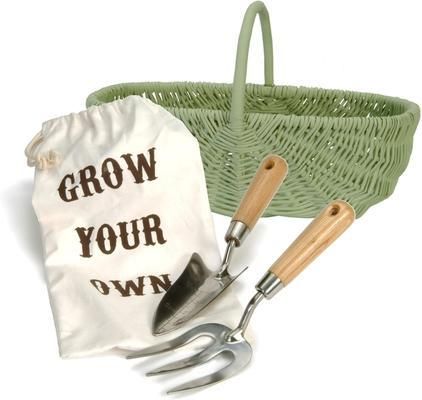
So there we go. Gardening as a literary endeavour. I've flogged the metaphor to death but it makes a change from my usual one of giving birth.
Here's hoping that some of the seeds we plant bear fruit and maybe even win prizes, whether they're for the largest marrow or the sweetest spinach.
Enjoy!
Subscribe to:
Posts (Atom)